Tag Archives: History

Salinas Pueblo Missions National Monument – New Mexico

Windows to an Ancient World
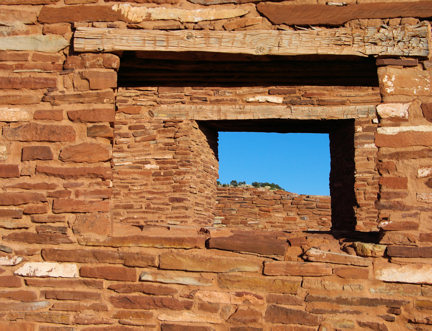
 spmnm-window-at-abo1

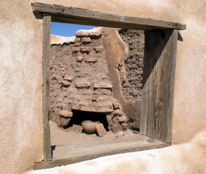
We stand in the afternoon light peering through window after window into the remains of an ancient world at Abo Ruins. The walls stand silent today but we can imagine the sounds reverberating through the village as women ground corn, masons shaped stones and children chased wild turkeys through the courtyard.

In today’s sparsely populated Estancia Basin of central New Mexico evidence of great pueblos recall a time when thousands lived in the valley. Clovis people hunted here 10,000 years ago. As prehistoric populations learned to grow corn they began to stay in one location longer, living in pithouses.
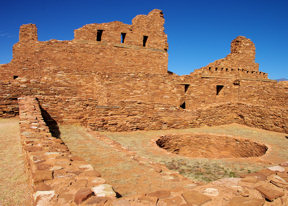
spmnm-abo-ruins1

Mission walls and kiva at Abo Ruins reflect the blending of Indian and Spanish missionary cultures.

Mesa Verde in southern Colorado was once the center of Anasazi culture. After abandonment of Mesa Verde circa 1300 some groups from that culture moved south along the Rio Grande and into the Estancia Basin. Stone villages and towns were built, fields farmed, trade flourished. Salt was collected from nearby lake beds, the commodity used for trade with plains Indians and other pueblos, such as Zuni 200-miles to the west.

In 1598 Spanish explorers entered the area, within the next 20 years missions were established in most of the Rio Grande pueblos. Fransican priests directed the building of churches and conventos, each larger and grander than the previous one. Cultural conflict, Apache raids, disease, drought and famine ensued. The entire Salinas district was deserted by both Indian and Spanish populations by 1677.

spmnm-view-from-abo

View from Abo Ruins

Three missions and portions of their villages comprise the Salinas Pueblo Missions National Monument. We’d passed through Mountainair, New Mexico on several previous trips only slightly aware of the missions. This time we stopped at the small in-town visitors center. A video and museum displays gave background information, piquing our interest in visiting the three sites: Quarai, Abo and Gran Quivira (Las Humanas).
spmnm-quarai-mission-walls1

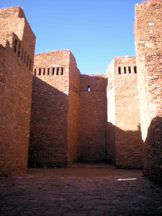
Interior of Quarai Mission

Quarai

Stepping through the entryway to the old stone mission church at Quarai I’m struck by the walls towering nearly 40-feet  high centuries after the last villager departed. Imagine the effort and engineering required to construct this grand church, the largest church of the Salinas Province as the Spanish called the region. The stones beneath our feet are believed to be from the original flagstone floor, an unusual feature since most mission church floors were packed earth at that time.

spmnm-church-quarai1

Quarai Mission


The mission at Quarai was built in the shape of a cross with side altars and a choir loft. Rows of empty sockets once held vigas, or roof beams; today we look up to open blue sky. We can imagine how imposing this structure seemed to the pueblo people use to living in small, low rooms.

Along a half-mile trail we see mounds signifying unexcavated house blocks, evidence of the 400-600 people living here before the Spaniards. After winding through the mission ruins the trail leads to the spring and stream that provided water essential for the community and fields. Giant cottonwoods shade the stream banks.

spmnm-abo-21

Abo Ruins

Abo

We arrive at Abo in the late afternoon, the low angle of the sun warming the red sandstone walls. The stone found at Abo broke easily into horizontal pieces. There’s more symmetry here than we see at the other two sites; row upon row, mortar of clay and water holds the tabular blocks together.

What strikes me at Abo is the sense of the convento – dining room, kitchen, storerooms, residence cells where the friars lived, porteria, stables and corral. This is where much of the business of the mission occurred. We don’t view these rooms from afar – the interpretive trail leads us along convento passageways and through waist-high doorways.
spmnm-view-from-gran-quivira-ruins

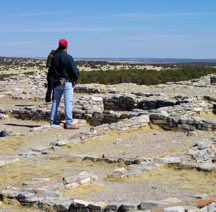
Mesa top ruins at Gran Quivira

Gran Quivira (Las Humanas)

We were so inspired by our stops at Quarai and Abo the next morning we decided to put Gran Quivira on the agenda. Called Las Humanas by Spanish explorers, Gran Quivira was the largest of the Salinas pueblos. Once home to as many as 2,000 people, today it is the most remote. From Mountainair we travel 25 miles southeast. Unlike the other two pueblos, Gran Quivira sits atop a mesa with no immediate water source. Runoff from sporadic rains was trapped in shallow pits to supplemented the limited water from wells and roof-fed cisterns.

spmnm-gran-quivira-overview

Gran Quivira Mound 7 and Church

As we approach the ruins we realize they are much larger than those we’ve seen at Abo and Quarai. Yet, Mound 7 is only excavated one of 20 house blocks that once stood at Las Humanas. The square-room ruins we walk through were constructed between 1550-1670, stones held together with an ashy-colored mortar. Beneath these walls archaeologists uncovered 200 wedge-shaped rooms arranged in five to six concentric circles built around a grand kiva. Yellow caliche mortar was used to construct this pueblo in the 14th century. We can stand atop the later pueblo and peer down a shaft into the lower rooms.
spmnm-gran-quivira-church-n

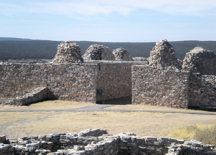
Unfinished second church at Gran Quivira

Construction on the first Las Humanas mission church began in 1630. The pueblo did not always have a resident priest, instead it was a circuit parish served by clergy from Abo. A second church was begun around 1659, the ambitious cross-shaped sanctuary never saw completion.

The museum at Gran Quivira exhibits examples of the various pottery styles used in the pueblos through the centuries.

Reflecting on our Salinas Pueblo Missions tour we realize that these churches were built, used for worship and totally deserted nearly a century before the first of the famed California missions was established. We’ve had the opportunity to see into an ancient world.

spmnm-grinding-stoneWhen You Go: Salinas Pueblo Missions National Monument is open daily except Thanksgiving, Christmas and New Years. The monument visitor center is in Mountainair, New Mexico. From Mountainair Abo is 9 miles southwest, Quarai is 8 miles northwest and Gran Quivira 25 miles southeast. Each of the three sites have a small visitor center and picnic areas. Camping is not allowed; campgrounds can be found in the nearby Cibola National Forest.

University of Arizona – Tucson, Arizona

Travel Destination – Campus Bound

I’ve long been an advocate of university and college campuses as rich resources for travelers. Some of the best art, historic and earth science collections are held by higher education institutes. The University of Arizona in Tucson perfectly illustrates my hypothesis.

University of Arizona Campus Highlights

  • arizona-t-shirt-logoUA Visitor Center– Campus information center, weekly guided tours, ticket sales for UApresents, parking. Open Monday – Friday 9am-5pm.
  • Arizona State Museum – Oldest and largest anthropology museum in the Southwest, Smithsonian Institution affiliate, world’s largest collection of Southwest Indian pottery, permanent and temporary exhibits, gift shop. The Paths of Life permanent exhibition showcases the origins, history and culture of American Indians of the Southwest with artifacts, historic items, artwork, videos and dioramas. Open Monday – Saturday 10am-5pm, Sunday noon-5pm. Closed state and national holidays. Suggested donation $3.
  • Center for Creative Photography – Museum, research center and photo archives, rotating exhibits. Established by Ansel Adams and UA, holds more archives and individual works by 20-th century North American photographers than in any other museum in the US. Gallery Store offers a large selection of photography related titles. Open Monday – Friday 9am-5pm, Saturday & Sunday 1-4pm, closed major holidays. Free admission, suggested donation.
  • Flandrau: The UA Science Center– Hands-on exhibits, planetarium and observatory for public viewing of night skies. Check website for hours and programs, admission fee, night telescope viewing free.
  • The Jim Click Hall of Champions – The heritage and traditions of athletics at the university showcasing student athletes and coaches. Hours vary, free admission.
  • The University of Arizona Museum of Art – Wide-ranging collections of European and American fine art from the Renaissance to contemporary. Changing exhibits and highlights from the permanent collections. Open Tuesday – Friday 9am-5pm, Saturday & Sunday 1-4pm, closed university holidays. Adult admission $5.

 UA Unique

  • SOML – Stewart Observatory Mirror Lab – Tours give a behind the scenes look at cutting-edge optical technology and spin-casting processes used in making giant telescope mirrors. Tours on Tuesday and Friday, reservations required, cost $15/person.

More on UA Campus

  • Campus Arboretum – Pick up a map and enjoy a campus walk among the unique collection of trees, shrubs and plants from arid and semi-arid climates. Free.
  • Performing Arts – Theatre, dance and music performances and film screenings staged throughout the year. Admission fees required.
  • Sonett Visitor Center– Self-guided tour at the Lunar and Planetary Laboratory – HiRISE Mars camera, the Phoenix Mars Lander and the Cassini mission to Saturn. Free, 520-626-7432.
  • UA Bookstore– I once heard someone espouse if you want your child to go to a particular university, as a pre-teen take them to the campus and buy them a sweatshirt. All sorts of insignia apparel and gifts are available at the official bookstore in the Student Union Memorial Center. 
  • UA Library Special Collections – Collections of rare books and archival materials in many subject areas including Arizona and the Southwest, changing exhibits.
  • UA Mineral Museum– Fabulous collection of minerals, gemstones and meteorites from around the world – over 2,000 on display. Located on the lower level of Flandrau: The UA Science Center. Check website for fees and hours.
  • UApresents – Professional performing arts – classical, jazz, blues and world music events plus dance performances. Admission fees.

UA off Campus

  • Biosphere 2– Management of the living laboratory of global scientific issues is now under management of the University of Arizona. Tours at the complex 20 minutes north of Tucson. Fee.

  • Boyce Thompson Arboretum – Plants from the earth’s varied deserts alongside unspoiled examples of Sonoran Desert vegetation. The Southwest’s oldest arboretum and botanical garden is located near Superior, 90 minutes from Tucson. Fee.

  • UA SkyCenter– Observatories atop Mt. Lemmon, SkyNights, DiscoveryDays and SkyCamps open to the public by reservation. Located 90 minutes north of Tucson. Fee.

Adjacent to Campus

  •  Arizona History Museum– Focus on southern Arizona history – Spanish colonial through territorial eras. Mining and transportation featured exhibits. Not part of the University but worth visiting while in the campus neighborhood. Check website for current hours and fees.

This list doesn’t begin to include all the possibilities, pick up a University of Arizona Visitor Guide and follow your interest from cutting-edge science to sport competitions. Be campus bound in Tucson.

Casa Grande National Monument – Casa Grande, Arizona

America’s First Archaeological Reserve

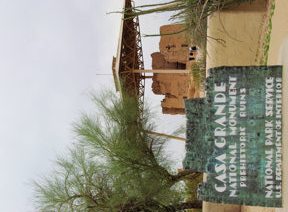
Arizona’s casa-grande-with-sign3Casa Grande National Monument preserves the remains of structures built by the Hohokam people in the 1300s. In the Gila River Valley these ancient people built over 1,000 miles of  irrigation canals, successfully growing corn, beans, squash, cotton and tobacco. Today several Native American tribes believe they have ancestral links to the Hohokam. The O’odham people of Southern Arizona still use the ruins for ceremonials and special events.

Spanish missionary, Father Kino, rode through the valley in 1694 and refered to the deserted structure as Casa Grande, or Great House, in his records. The site became the nation’s first archeological reserve in 1892 – the fifth oldest unit in the National Park system. Casa Grande was designated a National Monument in 1918.

We watch a 15-minute film and browse the compact but informative museum relating background on the Hohokam people and Casa Grande before taking the short walk out to the ruins. The largest structure – four stories and 11 rooms – has a metal roof protecting the ancient walls from weather damage. Signs along the self-guided path relate informative details.

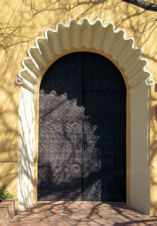
casa-grande-doorway1Unlike most of the ruins we see in the Southwest Casa Grande was not built with stone or adobe bricks. Caliche is a concrete-like hardpan found several feet below the surface in this region. The Hohokam mixed ground-up calice wth water to procude a sticky mud for building walls, sealing roofs and plastering walls.
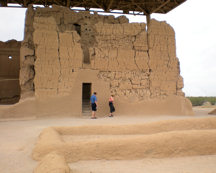

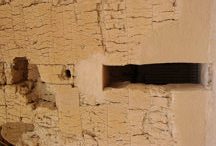
No one knows why the unusual structure was built or how it was used – center of government, education, religion or trade are speculations. I’m fascinated with how architectual details signify astronomical occurances. A small circular window in the west wall aligns with the setting sun on the summer solstice. A square hole in an upper wall aligns once every 18.5 years with the setting moon at an extreme point in its cycle. Additional windows and doorways align with the sun or moon at significant times of the year. Was this an observatory? We believe the Hohokam devised a calendar based on the motions of the sun and moon and incorportated that calendar into their architecture. Did it relate to their crops and farming?casa-grande-big-house2

Casa Grande was part of a much larger community. Excavated walls and unearthed mounds indicate several compounds comprised of houses, work areas, courtyards and storage rooms. In the center of the compound an oval ballcourt was used for community activities.

We don’t know the reasons Casa Grande was abandoned – disease, drought, flood, social or political issues. By 1450 the Hohokam culture, that had lasted 1,000 years, had come to an end. Today agriculture is still key to the region; irrigated casa-grande-cotton1fields support Arizona’s cotton industry. Standing in the shadow of the ancient walls and gazing across wind-blown fields one is almost transported into a world as the Hohokam knew it.
When You Go: Casa Grande National Monument is open 8am-5pm every day of the year except Thanksgiving and Christmas. The monument is located in Coolidge, Arizona about an hour’s drive from both Phoenix and Tucson.

Artists Wanted – Georgetown, Colorado

Historic Georgetown, Inc. Art Exhibition

georgetown-street

Colorado celebrates the 150th anniversary of the Colorado Gold Rush during 2009. Special events are scheduled in many communities throughout the summer.

Historic Georgetown, Inc. plans, “Archival Art and the Art of Mining,” a free exhibition at the Hamill House Museum Stables from July 25 to September 5, 2009. Opening and closing receptions are planned along with a live and silent auction.

If you’re an artist check their website for entry details and forms. Artwork must have a mining theme.

If you’re a Colorado resident or tourist this summer plan a visit to Georgetown and other communities celebrating our mining heritage. 

Northern Arizona Exploration Pass – Flagstaff, Arizona

Incentive Program to Scientific Wonders of Northern Arizona

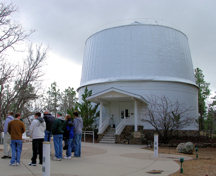
lowell-clark-domeThree premier attractions in the Flagstaff area have joined together to offer an Exploration Pass giving $2 discounts on admission to each the Lowell Observatory (see blog), Meteor Crater and the Museum of Northern Arizona. The free passes are available at the three attractions and the Flagstaff Visitor Center located next to the downtown train station.
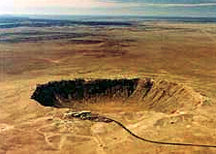
 

metero-craterMeteor Crater is located 35 east of Flagstaff. View the 4,000′ across and 550′ deep crater, explore space, meteorite and asteroid exhibits in the Learning Center, watch the “Collisions and Impacts” movie or take a one-hour guided rim tour.


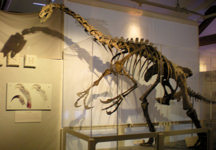
mna-dinosaurNine Galleries at the Museum of Northern Arizona introduces the visitor to the region through Native cultures, tribal lifeways, natural sciences and fine art. The Mystery of the Sickle-Claw Dinosaur exhibit introduces therizinosaur, the newest and strangest dinosaur skeleton found in North America.

Pick up a free Exploration Pass and discover scientific wonders from the depths of the earth to the heavens.

Fairbank Historic Townsite – Cochise County, Arizona

1880s Southwest Transportation Hub

fairbank-old-buildingPassengers stepping off  the train in 1880 Fairbank found themselves in a thriving transportation hub. Three railroad lines passed through the town, one connected with the Mexican port of Guaymas. From Fairbank passengers boarded the stage for the final travel leg into the mining town of Tombstone. An elegant hotel and restaurant, serving such delicacies as oysters on the half shell, provided creature comforts in the wilds of Southeastern Arizona.

Ores from Tombstone’s silver mines were brought to mills along the San Pedro River. Supplies and silver flowed through a flourishing Fairbank. The last bit of commerce and population hung on until 1974. Today wind whistles through the tinned roofed buildings. Bird song and woodpecker tappings replace the shrill sounds of an approaching steam engine.

fairbank-schoolhouseThe Bureau of Land Management acquired the old Spanish Land Grant that Fairbank was built upon in 1987.  The townsite is a gateway to the San Pedro Riparian National Conservaiton Area. Hiking trails lead to the Fairbank Cemetery, mill sites and along the river – an important habitat for both resident anfairbank-booksd migratory birds.

The stone Fairbank School has been restored and houses a small history museum, replicated 1930s classroom and bookstore/gift shop. The book selection is extremely well chosen with regional history and nature emphasis, travel and hiking guides and children’s titles. The Schoolhouse is staffed Friday through Sunday.

When You Go: Fairbank Townsite is located on State Route 82 halfway between Whetstone and Tombstone, on the east side of the San Pedro River. Visit the Land of Legends, the Cochise County visitors website for more information on Fairbank and other adventures.

Tumacacori National Historical Park – Tumacacori, Arizona

Stepping Back 200 Years

tnhp-vc-doorAs we step through the heavy wooden doors into the adobe visitor center at Tumacacori National Historical Park we begin the journey back two centuries. Jesuits arrived from Mexico to establish missions among the Piman Indians to bring Christianity to the New World. Father Kino established San Cayetano De Tumacacori in 1691.

After the Jesuits’ expulsion from New Spain in 1767-68 Franciscans were assigned to the missions. By 1800 they begun building a large church – one they hoped would rival San Xavier del Bac. The church was never complete as originally designed and by 1848 the last residents left Tumacacori.tnhp-church-in-arch

The National Historical Park encompasses remains of the church, cemetery, mortuary chapel, lime kiln and convento. A reconstructed O’odham house, patio garden, museum (currently closed for renovation) and book store are also part of the site. Mass is periodically held in the church and during our visit this afternoon the Santa Cruz Singers were arriving for a concert.

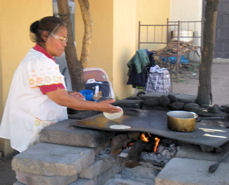
tnhp-through-the-window2Photographers find a plethora of interesting angles, framing and details. Today Dora Hernandez worked beneath a ramada making fresh flour tortillas. For a donation visitors topped their tortillas with beans, salsa and/or cheese and savored a bit of tradition. At a table in the courtyard an elder taught a young girl the art of cutting paper flowers.tnhp-tortillas
Hikers can follow the De Anza Trail from Tumacacori along the Santa Cruz River to Tubac.

While Tubac attracts a legion of tourists, Tumacacori calls me to stop along the journey and step back to an earlier time.

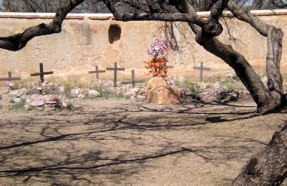
tnhp-cemetery

When You Go: Tumacacori National Historical Park is located 45 miles south of Tucson at exit 19 of I-19. Open 8am – 5pm daily except Thanksgiving Day and Christmas. There are picnic tables but no campground.

Trinidad, Colorado

Trinidad by Night

We originally planned to set off on our trip Saturday morning but upped departure time to Friday afternoon. Decided to get 200 miles down the road to have more time for tomorrow’s adventures. Made last minute reservations in Trinidad, Colorado – seven miles from the New Mexico border – and got out of town by mid-afternoon.

Arrived in Trinidad shortly after sunset. After getting into our room we looked in the phone book for restaurant listings. There’s a full service restaurant in the hotel but that would be too easy and predictable. We like the menu for Cougar Canyon Fairway Grill.

Driving through town we see lots of cars at Chef Lui’s, “Chinese, Seafood, Cocktails,” and Rino’s Italian Restaurant & Steakhouse. The historic downtown seems quite alive for eating and drinking. Heading east of town Bob’s sure we don’t know where we’re going – all the more adventure. Cougar Canyon turns out to be a Golf Resort Community under development.

The Fairway Grill adjoins the golf shop. It’s obvious we’re the only tourists but we’re welcomed warmly by all of the staff. Next door a 117-room hotel is under construction, scheduled for completion by July 1, 2009. Under the pitch black star-studded skies we see not a foot of the Nicklaus Design golf course but the pictures intrigue with pedestal greens, split fairways and rocky canyon walls. Golf magazine named Cougar Canyon one of the “Top Ten Courses You Can Play in the U.S.” Although I’m not a golfer I have to come back in the daytime to see the course and its sweeping views of the Sangre de Cristo Mountains.

Instead of just passing through I want to make Trinidad a destination some day. The community’s rich history is preserved in the Corazon de Trinidad National Historic District. The Trinidad History Museum encompasses heirloom gardens and three landmark buildings including the Baca House, The Santa Fe Trail Museum and the Bloom Mansion. Just west of town we’ll find Trinidad Lake State Park and, further along the Highway of Legends Scenic Byway, Blue and Bear Lakes. A future Trinidad visit will reward with fascinating history, outdoor recreation and natural wonders.

Visiting Abraham Lincoln Sites

All Things Lincoln

 Two hundred years ago Abraham Lincoln was born in a simple Kentucky cabin. With little formal education but great vision, determination, and integrity he abolished slavery and preserved the Union of the United States. Even 144 years after his death the impact of his leadership lives on. Honor the 16th President by visiting one of the sites memorializing Lincoln.

Abraham Lincoln Birthplace National Historic Site – Hodgenville, Kentucky

Lincoln Boyhood National Memorial – Lincoln City, Indiana

lincoln-memorial2Lincoln’s New SalemState Historic Site – Petersburg, Illinois

Lincoln Log CabinState Historic Site – Lerna, Illinois

Lincoln/Douglas Debate Museum – Charleston, Illinois

Lincoln Home National Historic Site – Springfield, Illinois

Lincoln – Hendon Law Offices – Springfield, Illinois

Old State Capitol – Springfield, Illinois

Ford Theater National Historic Site – Washington D.C.

Lincoln Tomb – Oak Ridge Cemetery, Springfield, Illinois

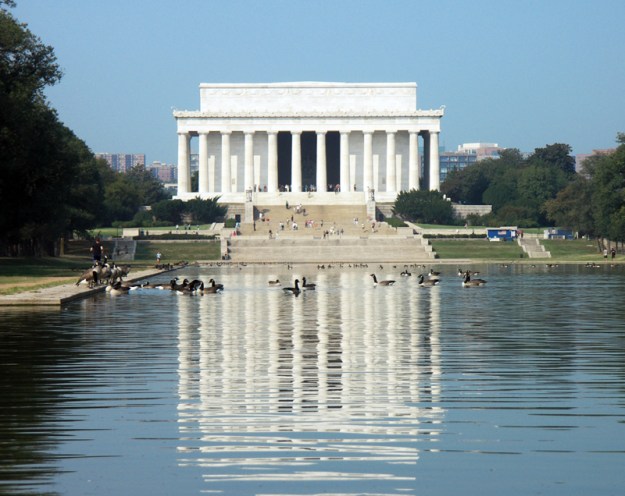
Lincoln Memorial – Washington D.C.

*Rant* – Shame on You, State of Illinois

More Shame for the State of Illinois

There are times when I’m embarrassed to admit I’m from Illinois. My ancestors moved westward with the frontier in the early 1800s from Virginia, through Cumberland Gap, stopping in Ohio and Indiana before finally settling on the Illinois prairie. Reality is that Central Illinois was a great place for growing up and gave me a firm basis for the values I hold and who I am today. However, the shameful political history is an embarrassment and against all values learned on Illinois soil.

As if the recent governor debacle isn’t bad enough when I sat down to write about my visit to the Abraham Lincoln Presidential Library & Museum I made a new discovery. The Governor’s Office under the orders of now – thankfully -ex-governor Rod Blagojevich  has closed 25 historic sites and state parks including four designated National Historic Landmarks. Reviewing the list I see that none are in Chicago or Cook County, the great sinkhole of state funds goes untouched while places like the Carl Sandburg home, Fort Kaskaskia (Illinois’ First Capitol), Kickapoo State Park and the Vandalia Statehouse are shuttered and barricaded. Any member of the public entering the closed parks or sites will be arrested and charged with trespassing. Now, isn’t that a friendly use of taxpayer money?

Sites directly connected with Abraham Lincoln are among those closed. Just in time for the 200th anniversary of Lincoln’s birth. Vandalia Statehouse was the location of most of Lincoln’s time as a member of the Illinois state legislature.

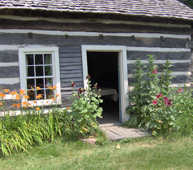
lincoln-log-cabin-2Lincoln Log Cabin State Historic Site was the location of Thomas Lincoln’s farm from 1840 until his death. While Abe never lived on the site he owned and maintained the farm for his stepmother, Sarah Bush Lincoln, after his father died in 1851. He stopped to visit Sarah in early 1861 on his way to his presidential inauguration.

Located eight miles south of Charleston, Illinois the historic site encompasses a replica of Thomas’ log cabin surrounded by a subsistence farm with heirloom crops and cattle breeds. The Stephen Sargent home, reflecting the practices of successful cash crop farming in the 1850s, is also part of the site. Nearby is the Reuben Moore Home where Lincoln and Sarah met for a final time. A living Abraham Lincoln never returned to Illinois.

The need for a replica log cabin holds quite a story. In 1893 the original cabin was disassembled and shipped to Chicago for the World’s Columbian Exposition. Somehow after the exposition the cabin was lost – perhaps used as firewood. Many photographs existed and a replica was built by the Civilian Conservation Corps in 1934.

Before the Blagojevich closing both the Lincoln and Sargent farms supported an active living history program. I’ve visited many such programs around the country and this was absolutely one of the best. The participants weren’t actors or characters, they lived life as the original families would have – growing crops with tools of the period, raising cattle, mucking out the barns, cooking over wood-burning stoves, eating with crude utensils. Authenticity went right down to the hand sewn period underwear worn by the interpreters. This was the only site in the state of Illinois to offer regular first person interpretation.

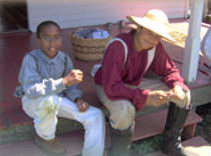
lincoln-log-cabin-kids1In 2008, volunteers gave over 13,000 hours of their time to ensure that Lincoln Log Cabin was open and accessible to visitors from all 50 states and many other countries. Volunteer support enables the Fifth Grade Live-In and Summer Youth Educational Programs.

The Lincoln-Sargent Farm Foundation is a nonprofit private group that supports the educational programming at Lincoln Log Cabin State Historic Site. Foundation board members are evaluating what potential exists for the foundation to assist the site during the forced closing. Please consider making a donation to help support the efforts of the Foundation in maintaining educational programming and the preservation of rural heritage. Click here to download a form for mailing.

I’m betting the hard working, dedicated volunteers will find a way to overcome the obstacles created by “their” state government. Plus, my check will be in tomorrow’s mail.